

On a bright sunny day on October, Kelly Hopping and Renee Kehler hike up a mountain in Deer Creek canyon near Hailey, looking for sheep.
Where do you see the sheep?
“They’re right up there in the saddle,” says Renee Kehler, a Range Management Specialist for the U.S. Forest Service.
We reach the saddle, and the mountain is literally moving with sheep.
“Yeah they’re heading to plot 4, and then down into 2 and then 3,” says Kelly Hopping, the research team leader for Boise State University.
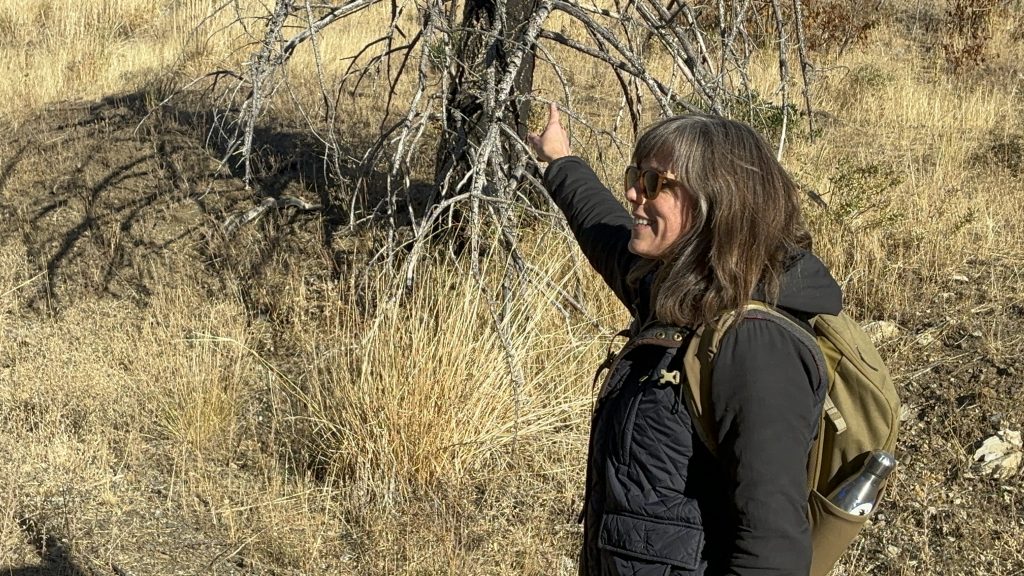
Boise State University Professor Kelly Hopping points toward a band of sheep grazing in a research plot nearby. (Photo by Steve Stuebner/LOTR)
An Associate Professor of Human-Environment Systems at Boise State University, Hopping is finishing up the 3rd year of a research study to see whether targeted grazing with sheep can reduce cheatgrass levels on the range.
Sheep are a browsing animal that typically eat forbs, grasses and shrubs on rangelands.
Most of the targeted grazing projects or research studies have used cattle as a tool to reduce cheatgrass, since cattle eat primarily grass.
“I think it’s a good opportunity to use sheep to graze the cheatgrass because it’s something that hasn’t been looked at as much before,” Hopping says. “People are usually using cattle for good reason. Since these allotments are permitted for sheep, we thought it’d be worth trying.”
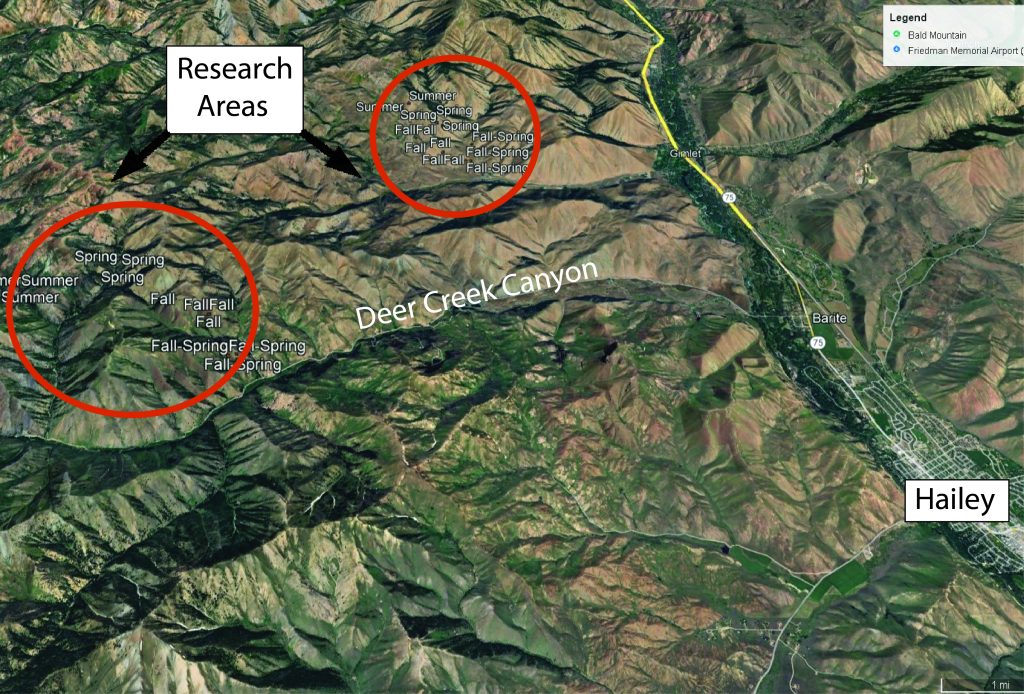
Location of the BSU targeted grazing research project.
Hopping set up 32 research plots in the Deer Creek and Limekiln grazing allotments. She worked with Renee Kehler of the Sawtooth National Forest and sheep ranchers Riley Kowitz and Mike and Mark Henslee to identify the best spots for targeting cheatgrass.
On this sunny October day, she’s happy to see the sheep grazing on three different fall targeted grazing plots, right where they’re supposed to be.
“We’re finding a real advantage is that sheep have herders with them, and the herders can direct where they go, and can target specific areas, so it’s been great working with them,” she says.
After three years of collecting data, Hopping’s research team has found that sheep will eat cheatgrass in the spring and fall. But the timing is key. It all depends on the weather, snow, fall rains and whether the cheatgrass is greening up and palatable to the sheep.
“We’re finding a lot of variability in weather and that affects the plants and the results we’re getting with the sheep,” she says.
She’s hoping to extend the project another three years. “Every year the weather is so different, that makes it really hard to draw conclusions, wet years and dry years, so with more years of data, we can be more confident about it.”
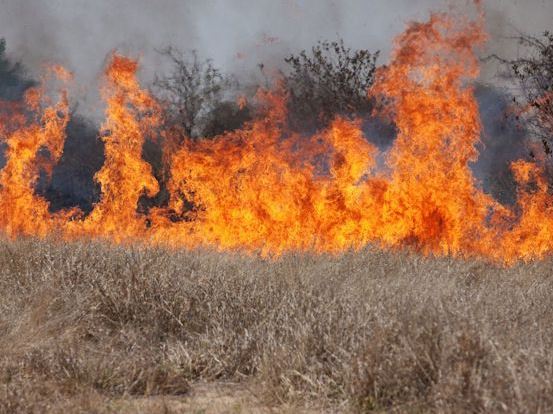
Cheatgrass becomes very flammable after it dries out, causing damage to the range.
What is Cheatgrass? Why is it so bad?
Cheatgrass, also known as Downy Brome or by its Latin name, Bromus tectorum, is native to Eurasia. It was accidentally brought into the United States in the 1880s via ship ballast, contaminated crop seed, packing material and other means.
Once introduced to the U.S., cheatgrass quickly spread into the Great Basin of the West. By 1980, cheatgrass had spread to every county in Idaho, Montana and Wyoming. It’s an opportunistic annual plant that greens up earlier than native plants, and outcompetes perennial grasses and forbs following wildfires and ground disturbance.
Once cheatgrass dries up in late spring, it becomes a serious fire hazard.
Research in the Intermountain West predicts that areas with 15% or higher levels of cheatgrass infestation are twice as likely to burn as native range, and four times more likely to burn multiple times over the long term.
So the idea of using sheep to reduce cheatgrass levels in areas like Deer Creek canyon and Limekiln Gulch could be valuable.

Fall grazing on cheatgrass in Deer Creek canyon. Hopping and Renee Kehler are off in the distance, watching the sheep.
“It would be a huge, huge management tool,” Kehler says. “The permittees have continually told us that they will eat it, they come through the desert before they get here, and that’s all they have to eat. Here, there are lot more choices for the sheep, so we wanted to see if we could make that happen, in an area where they had choices.”
Sheep rancher Riley Kowitz agrees. “It was a great idea. We got all of these sheep that need resources so we might as well use some of those resources to clean up some bad resources.”
 The research project is exploring two other questions:
- Does targeted grazing with sheep have any unintended consequences to native plant communities or the soil?
- If cheatgrass levels are reduced, how does that affect fire danger and fuels connectivity?
Spring Research begins with putting GPS collars on the sheep
In the spring, the research season begins with catching 40 ewes and putting GPS collars on them.
Sheep rancher Riley Kowitz grabs the rear hoof of an ewe, and Maddi Sorrentino quickly puts an orange GPS collar on the sheep, making sure it’s not too tight.
“It was a little bit of a rodeo, it goes fast,” notes Boise State graduate student Maddi Sorrentino. “The sheep (catchers) are amazingly effective.”
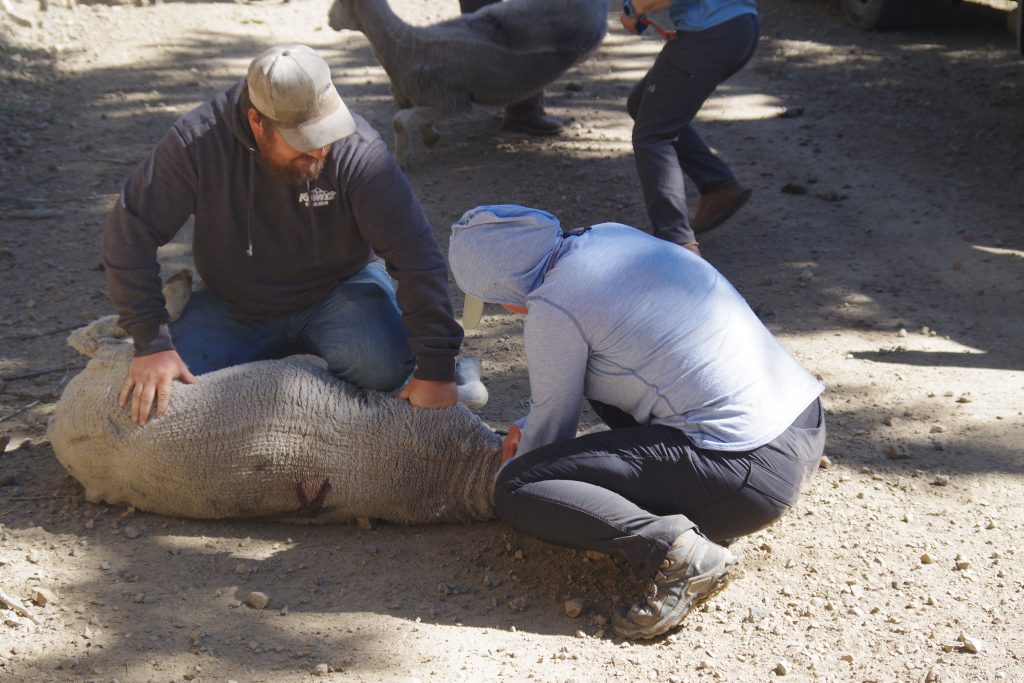
Kloe Walter puts a GPS collar on an ewe while rancher Riley Kowitz holds the animal in place.
The GPS data is a key part of the study.
“That allows us to track where the sheep are going and make sure they are making it into our study plots and it allows us to figure out how much time they spend in the study plots.”
Once the GPS collars have been put on the sheep, the animals run for the hills in search of fresh spring feed.
In Deer Creek canyon, data-gathering from the research plots track results where cheatgrass occupies at least 15 percent of the range.
“That was a big job coming up with all the plots,” Hopping says. “We used a lot of satellite imagery of where cheatgrass is, then we would hike literally hundreds of miles to find places, then talked with Riley about what would be some realistic routes for the sheep to get between the plots.”
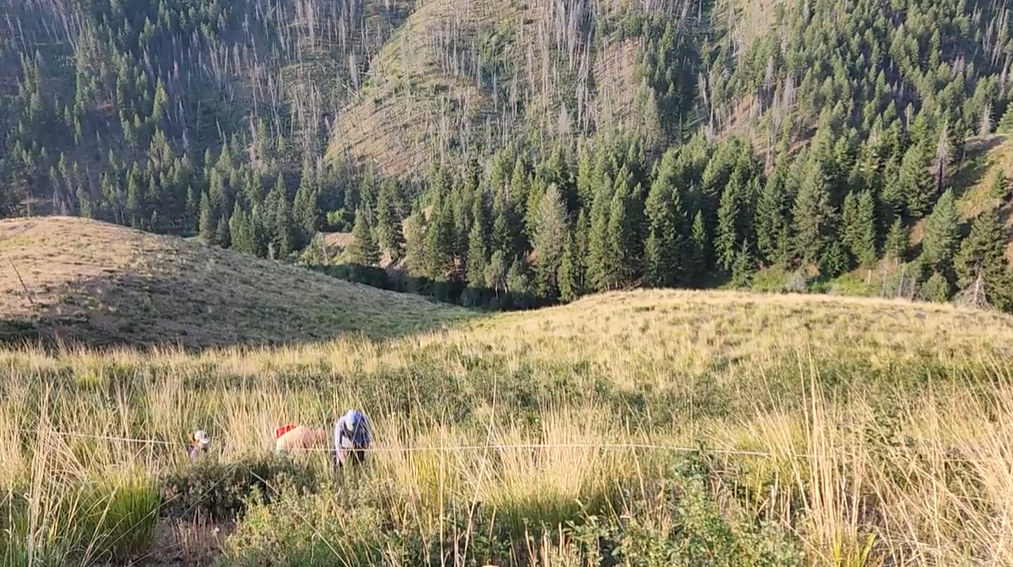
Boise State graduate students take field measurements in the summer. (courtesy Boise State)
In July, Hopping and the graduate students head into the field to gather research data.
“We measure the plants in terms of what species are there, how much area are they covering, that includes the cheatgrass as well as the other plants that are there, to try to understand the impact on wildflowers, perennial grasses and all the plants, so that’s a lot of the detailed measurements,” she says.
“Every 10 meters, we set up a little PVC pipe frame, and clip everything inside the frame, to get quantity of plant material, get back to the lab, dry it, weigh it, for cheatgrass, for dead plants, for grasses, wildflowers, how much is there after the grazing treatments.”
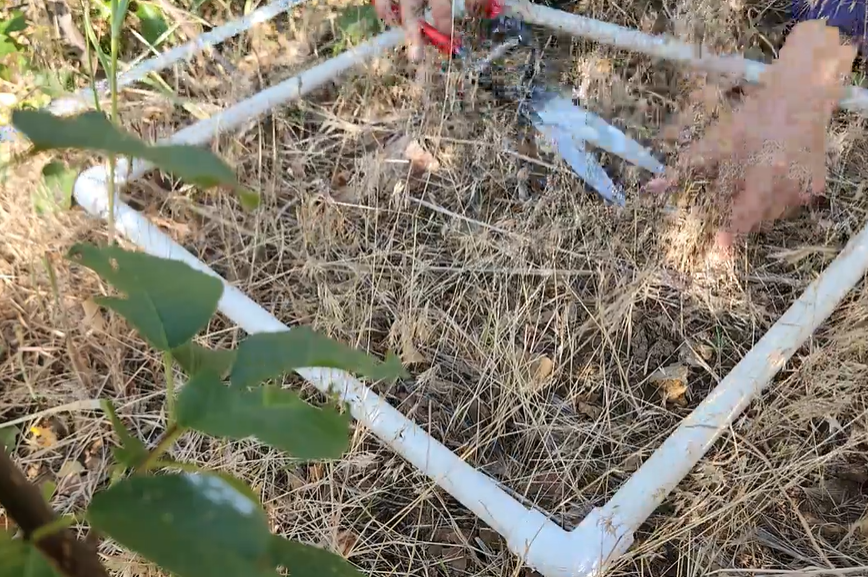
Taking grass measurements in the field. (courtesy Boise State)
In the spring, research results show that the sheep consumed native grasses, forbs and an equal amount of cheatgrass. In the fall, the sheep ate more cheatgrass and did not significantly affect native grasses and forbs.
Sheep herder Roberto Roman says the sheep seem to eat more cheatgrass in the fall than the spring.
“Ah, of course. When it’s dry and there’s no other feed, they eat it really good (fall grazing),” Roman says (in Spanish, translated to English). “In the spring, when everything is green, it’s not their first choice.”
The soil research could be illuminating, too.
“Cheatgrass is really good at using nitrogen and out-competing the native plants for it. So there’s a possibility that with sheep in the plots, they could be adding nitrogen and fertilizing it, and that would benefit cheatgrass,” Hopping says.

Seed bank study tracks what type of grasses and plants emerge from soil samples collected in the field.
April Hulet, a range professor at Brigham Young University, is looking at how reduced cheatgrass infestation levels might affect fire danger and fuels connectivity.
“We measure the gaps between the canopy, and that informs how wildfire would move through the system,” Hopping says.
Some soil samples are placed in a greenhouse to see what sprouts. She calls that the seed bank study.
“The cheatgrass is just so prolific, we’re seeing hundreds and hundreds of seeds germinating per square foot of soil, so that just tells you the magnitude of the problem,” she says.
Native grasses and shrubs are growing in the greenhouse, too.
Over the life of the research project, new ideas keep sprouting.
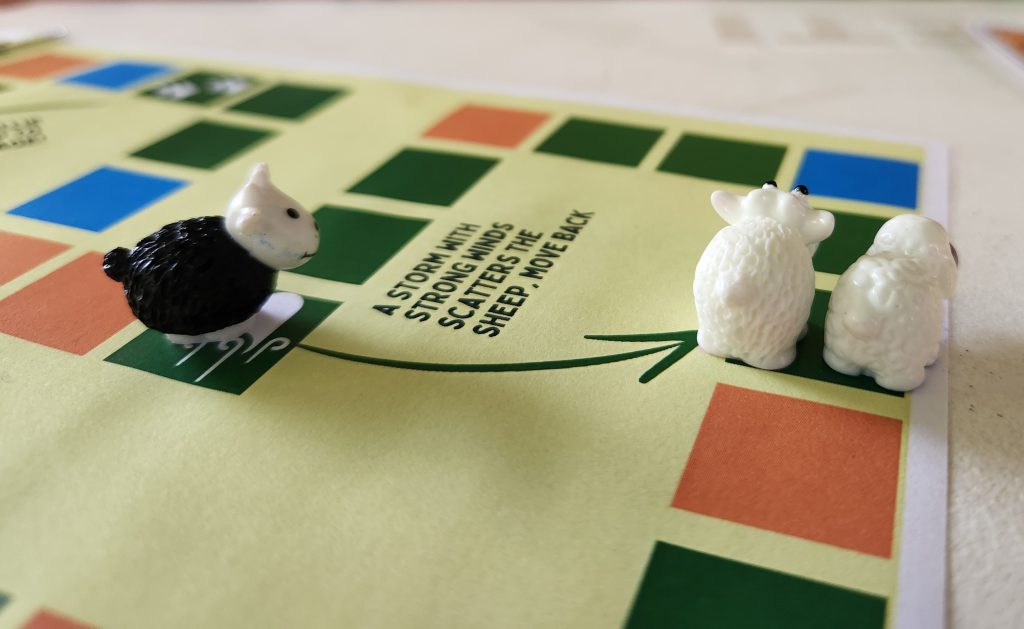
Targeted grazing with sheep board game
“There’s a couple of graduate students from BYU working with April Hulet, who made a targeting grazing board game that teachers can use in the classroom,” Hopping says.
Overall, the targeted grazing with sheep research project has gotten larger in scope with more collaborators over time. A key draw seems to be everyone’s interest in working with the sheep in a beautiful area.
“I got into this because I’m interested in agriculture, and I really love sheep. That has been really, really rewarding to work with sheep,” Sorrentino says.
“Probably my favorite part is doing actual grazing treatments. Because we get to be out here with the sheep,” adds Kloe Walter, a Boise State graduate student. “But it’s also really cool to work with our amazing collaborators, I feel like, we’re so lucky to have the producers we work with. The sheep herders are so nice, it’s such a great experience. More than I thought it would be … it’s really amazing.”
“People like to be out here, so we have the advantage of a really beautiful place where our project is located, people enjoy coming out and being part of it,” Hopping says. “It’s been a wonderful experience, the best part of my job is being out here with the sheep, working with the forest service and the producers, this is the best part.”
© 2024