
It’s the beginning of May in Washington County, Idaho, and everything is glowing emerald green.
The bright yellow blooms of arrowleaf balsamroot light up the landscape.
Some of that beautiful greenery has a bad side, however. They are noxious weeds invading the countryside.
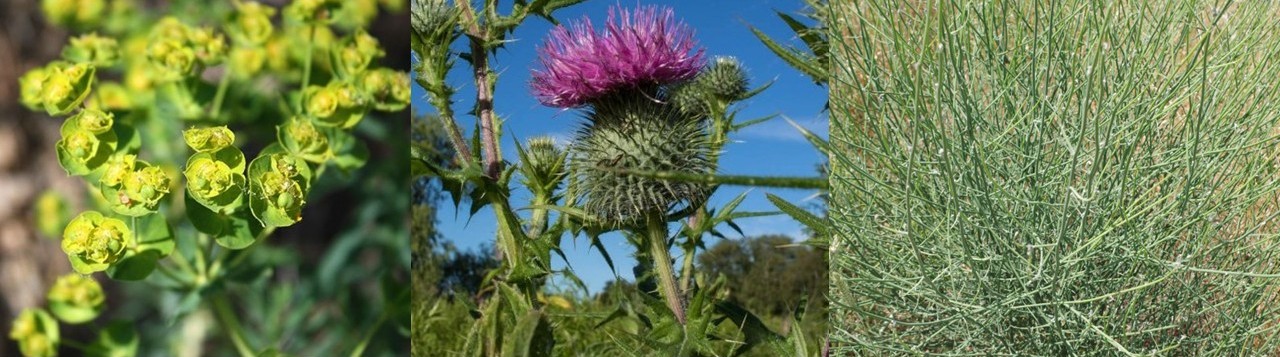 Leafy spurge. Scotch thistle. Rush skeletonweed.
All of those invasive weeds pose major threats to native perennial plants on private and public rangelands in Idaho, and they are among the primary noxious weeds targeted for treatment in Washington County.
On May 1st, Washington County landowners came together to control those noxious weeds.
“Today we’re having a cooperative weed management area neighborhood spray day,” said Bonnie Davis, Washington County Weed Superintendent. “It’s not nearly as overwhelming when you’re out working together. It’s all about cooperation, and spending time together as a community.”
The spread of noxious weeds – non-native invasive plants – are considered one of the top three primary threats to rangeland ecosystems in the West.
 They can outcompete native plants and forbs, take over vast acres of land, increase fire hazard, and negatively affect livestock and wildlife. The economic impact of noxious weeds taking over rangeland can be huge.
Plus, Idaho state law requires property owners to control and prevent the spread of noxious weeds.
Justin Mink, a Washington County rancher, understands those obligations. That’s why he’s a leader on Neighborhood Spray Day in Advent Gulch.
Take care of the weeds, take care of the things we need to take care of to be good stewards, and two, allow that next generation to come back in,” Mink said.
The Mink family has been building their operations for four generations, with the fifth coming on strong. Family members all come together to herd cattle onto their spring range.

Justin and Jodie Mink and their three sons working cattle on the range.
“I like pushing calves,” said Jarret Mink, one of three boys raised by Justin and his wife, Jodie.
“That’s always been our goal, I feel we’re working pretty hard towards that,” Justin Mink says. “You have to have your best management practices moving forward. Otherwise, you won’t have a future.”
The Mink family depends on their private lands in Advent Gulch – it’s their spring range for cattle. Keeping those lands as free of noxious weeds as possible leaves room for native plants to thrive for livestock and wildlife.
Cambridge Rancher Royce Schwenkfelder feels the same way.
“The noxious weed issues are a detriment to all of range health,” Schwenkfelder says. “Native plants don’t survive when noxious weeds take over the landscape.”
Controlling weeds is crucial to Royce and Pam Schwenkfelder because they raise cattle on their 12,000-acre ranch year-round.

“It’s all we got,” he says. “On our deal, we’re going to make our best effort to try to cause a positive effect on what we own.”
“Now when there’s a drought or a fire or weeds, something bad happening, it’s all on me, or Mark Maura and our crew, to figure out how to manage through that.”
Ranchers like Justin Mink and Royce Schwenkfelder show why Washington County has been a leader in noxious weed management in Idaho. The county created a Cooperative Weed Management Area 25 years ago.
Quick history. Midvale rancher Dave Springer was there at the beginning, leading the way. They put together an advisory board including landowners, the Forest Service, Idaho Fish and Game, and the Bureau of Land Management.
“We blurred boundaries, and agreed to work together to go after the noxious weed problem,” Springer said. “The
concept was to provide a means for the average landowner, and the agency people, to address the noxious weed
program, and comply with the Idaho Noxious Weed Law. That’s what the whole story is about, and it’s been reasonably successful.”
 Neighborhood Spray Day helps motivate landowners to come together for a common cause.
“We do 12 different neighborhood projects, two days at least, and we have anywhere from 8-10 people on a project to 35,” Davis says. “People look forward to spray day. You don’t want to miss spray day. It’s a really popular thing.”
Davis pre-mixes the herbicides for landowners on spray day to ensure the right chemicals are used to control specific weeds.
“Our cooperative weed management system is a really good system. That allows people to rally. That’s really important,” says Tim Prather, a noxious weed expert as a Professor of Plant Science at the University of Idaho.
Neighborhood Spray Day also serves as an educational reminder to new landowners about the legal obligation they have to control weeds on their property.
“We have a strong education program,” Davis says. “We do a lot of flyers and mailers and classes. And those things are all important. People have to learn what’s here. And they have to learn that we can control them. One bite at a time. One day at a time.”
And they are seeing positive results.
“When we first started, you didn’t have to look more than five feet and you were into thistles or spurge or something to that effect. And that was affecting our grazing,” Mink says.
“Once the project gets going, that’s the enjoyable part of it, seeing the results.”
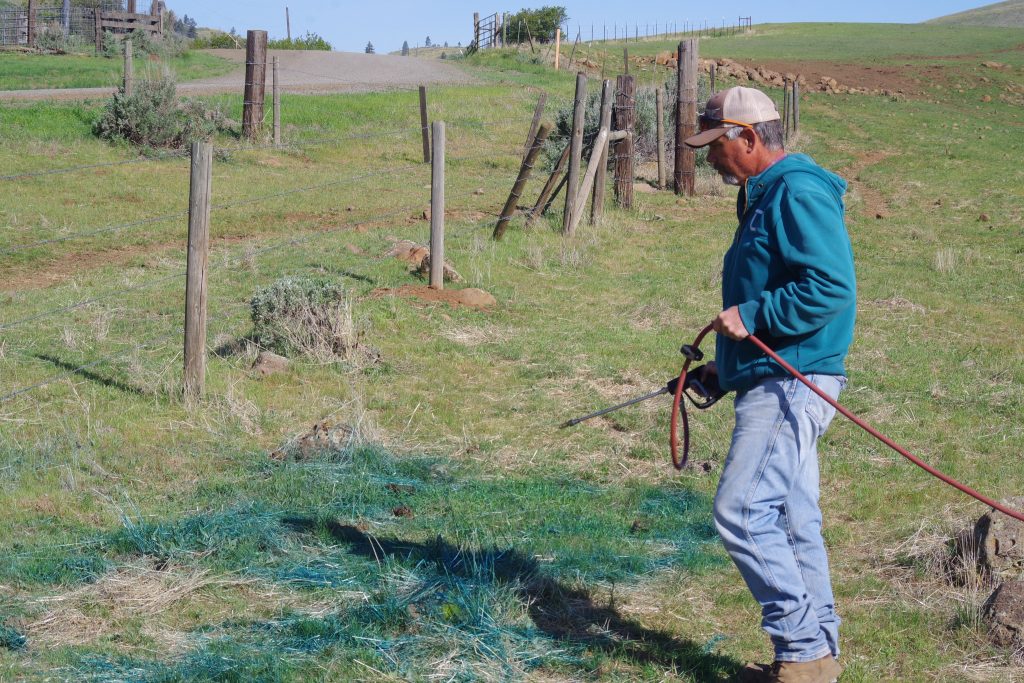
Rancher Justin Mink sprays some white top weeds with an herbicide.
“They’ve been doing this four-day project in this area for numerous years now, and it’s been a great success,” Davis says.
Prather, who is the author of the University of Idaho’s best-selling guide to Idaho’s Noxious Weeds, recommends taking an aggressive approach. “Yes, catch things when you can when it’s still limited.
Davis and the landowners doubled down on treatments after the Woodhead Fire burned 100,000 acres in 2021.
“The Woodhead Fire here was a huge set back. It was devastating what it did to this range,” she says. “They’ve worked hard to restore that land. It woke up all that seed. But they’re diligent, they’re determined, and they are going to win this war.”
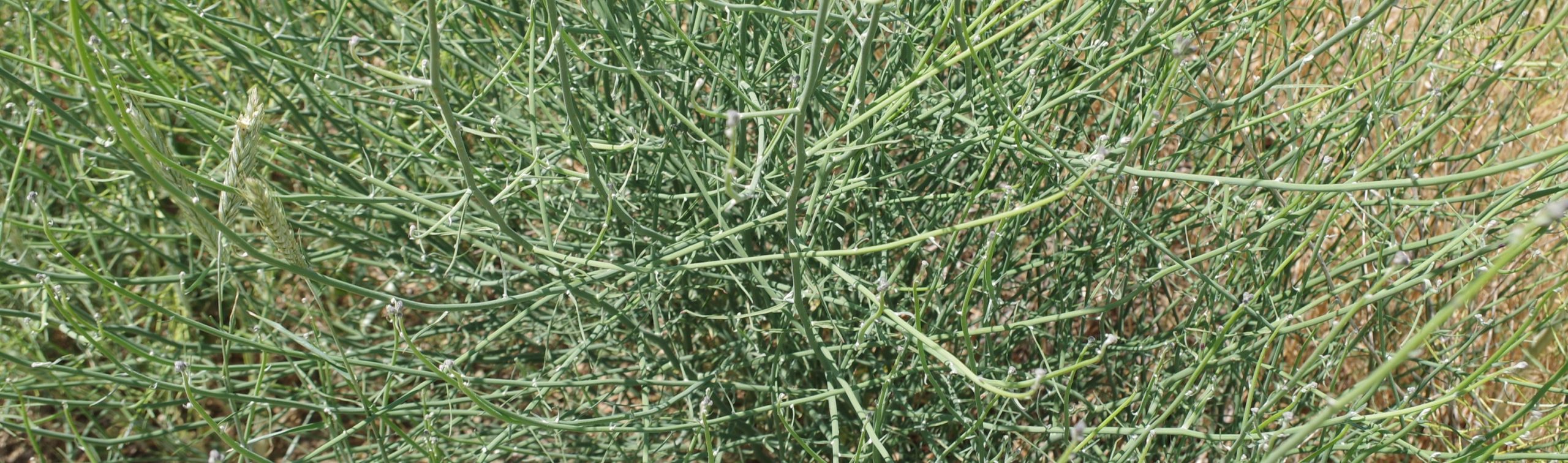
Management options for Rush Skeletonweed
Schwenkfelder has been working with Prather for years to determine the best ways to control rush skeletonweed – one of the most prolific noxious weeds in Idaho.

Map of Rush Skeletonweed invasions statewide.
The weed occupies more than 3 million acres of rangelands in Idaho.
Biological control can help.
“This is rush skeletonweed,” Prather says. “What we’re seeing is activity from the various biological control agents that are on rush skeletonweed. When we see one the size of a thumbnail, there might be 4,000 mites in that particular gall. Those mites live for about 11 days, when these galls dry out, the female picks up what’s called a spermadafore, and they impregnate themselves and go to another growing point and start a new gall.”
The bio-controls don’t eradicate rush skeletonweed, but they significantly suppress growth and seed production.
Getting down to the fine details of land and weed management, Prather says bio-controls do better if rush skeletonweed tries to sprout in a stronghold of perennial grasses.
Perennial grasses can limit the resources available to the plant, so that plant grows more slowly, and the mites can catch up and grow.”
He recommends herbicide control on skeletonweed in areas where you have a high density of perennial grasses. A study showed that with at least 16 percent ground cover with perennial grasses, rush skeletonweed will struggle, he said.
“At that point, you can spray, and you may not have to spray again, provided we can get these control agents going. And then things are in a balance,” Prather says.
Drone weed control
Overall, rush skeletonweed is a tough challenge, Schwenkfelder says.
“We started by trying to farm it off, and that didn’t work because it loves to be killed off,” he says. “It just produces more plants because that’s the way it works. It has a very deep root, comes up above the ground like a crown, and if you cut the crown off with a shovel or a disk or a plow or anything, it just uses those roots and makes 5 or 10 more plants.”
So Schwenkfelder uses a mix of range management, herbicide control and biocontrol to manage rush skeletonweed.

Mark Moura flies a drone to control noxious weeds on the SS Cattle Co. ranch in Cambridge.
He invested in a large drone to control invasive weeds more effectively in topsy-turvy terrain. His son-in-law Mark Moura flies the drone.
Using their drone, they can get more uniform coverage and use less chemical for the best results.
“One thing that’s happening in the whole industry is you might over-chemical your ground, you’ll decrease your production if you put too much chemical on,” Schwenkfelder says. “If you can get down on a 25-foot height with a drone you can just follow along the ground at a slow pace, and very specifically put that chemical where it needs to be. And maybe you could do that with 4 ounces instead of a pint and a half.”
“I’m pretty excited about it. We need to tap into all the information we can find to keep improving rangelands.
“We’ve morphed from privately looking at our weed thing to it being a community thing, a little bit, and then further, we’re doing things that we think can perpetuate range management. Adding that weed control piece is a big deal, it goes along with a positive approach to range management because it’s your responsibility.”
“We’re 25 years into this now, and it’s still working,” Springer adds. “Noxious weeds are still noxious, and still growing,
but we’re trying to keep them under the control, and that’s the whole objective, to keep them under control.”
Steve Stuebner is the writer and producer of Life on the Range, a public education project sponsored by the Idaho Rangeland Resources Commission.
© 2025